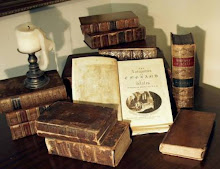
Well, the competition was fierce. Creative reasoning was thin, so ultimately the selection must be made on who will benefit most. Your Bibliothecary assembled a panel of four unknown judges to review the applications, and the selection was made following a three hour deliberation, and a Twinkie break. The envelope please...
And the winner is...
Stefanie.
[Aside]:Please email your mailing address so that we can post your prize promptly.
Though this was not a unilateral choice, Stefanie clearly made an attempt to appeal (which was part of the criteria) to your Bibliothecary, by reading his blog and coming to understand him as fair-minded, kind, and generous. She was also able to discern his appreciation of humility and honesty. She already possesses the other of what works well as a pair of books on writing, and together they should be. And she did skirt the creativity condition by stating "My artistic future just might be in your hands."
All judging aside, your Bibliothecary has been stirred to thoughts on Stefanie's comment. When is one a novelist? If you read a book, you are a reader. If you write a novel, you are a novelist. We who write should not need validation of who we are from anyone.
Or does one only become a novelist when one's novel is read? This harks back to my earlier musings in the action-packed Chapter Forty-Seven. Is it a novel if it is merely written but never read, or does it fully become a novel only when read?
What if you self-publish? Unless one is also a successful promoter, one's novel might still remain unread. What if one's novel is published by a small press? Or does it truly require the acceptance by a major publishing house for one to finally congratulate oneself for being a novelist?
When one begins to think in terms of novel-length fiction, to conjure characters and ponder plots, to envision scenes and tinker with titles, one is already becoming a novelist. When one puts pen to paper (or finger to keyboard) and begins the writing process, one is a novelist. Perhaps one will cross the finish line of NaNoWriMo but never write again, and then one will be a former novelist. Perhaps one may never finish the novel that is begun, and then one will be a failed novelist. Perhaps one will earn a $400,000 advance from Random House, and then one will be a successful novelist. But the very fact of writing the novel gives one the title.
For your Bibliothecary, reading about writing, its rules and craft, fascilitates inspiration. Writing is a craft and requires practice. Stefanie has already been published, making her work public on the internet. She is already a competent essayist. And it would seem she has become a novelist, too.
Congratulations.
Monday, October 31, 2005

Sunday, October 30, 2005
Chapter Fifty-One, in which your Bibliothecary is an obsolete Skill
Like Sylvia, I don't normally take these quizzes. I once was looking for a fun activity for the Job With A Paycheck, and I discovered the Disney character I am most like is Minnie Mouse. Anyway, this one intrigued me, and if Sylvia can play along, so can I. And my results are in:

Interesting, considering regularly metric verse, especially blank verse, is my least favorite of all forms of poetry (although William Blake is not half-bad). I do, however, appreciate the beautiful things in life.
What Obsolete Skill Are You?
You are 'regularly metric verse'. This can take many forms, including heroic couplets, blank verse, and other iambic pentameters, for example. It has not been used much since the nineteenth century; modern poets tend to prefer rhyme without meter, or even poetry with neither rhyme nor meter.
You appreciate the beautiful things in life--the joy of music, the color of leaves falling, the rhythm of a heartbeat. You see life itself as a series of little poems. The result (or is it the cause?) is that you are pensive and often melancholy. You enjoy the company of other people, but they find you unexcitable and depressing. Your problem is that regularly metric verse has been obsolete for a long time.
Interesting, considering regularly metric verse, especially blank verse, is my least favorite of all forms of poetry (although William Blake is not half-bad). I do, however, appreciate the beautiful things in life.
What Obsolete Skill Are You?
Chapter Fifty, in which your Bibliothecary enjoys a Pipeful of Christopher Morley
We have mentioned this wonderful all-around literary man in previous chapters, and it seemed like a good time to add a little depth to the praise.
Morley began as a reader for Doubleday and was adept at identifying promising writers such as William McFee, Pearl S. Buck, and Stephen Vincent Benet. He became a regular newspaper "colyumnist" which gave him the opportunity to roam and discover or invent things literary and fun. His published novels are what he is best known for today. He also was a great essayist, speaker, and a prolific founder of clubs: the Three Hours For Lunch Club is one to which we all would like to belong, and as a member of the first panel to make selections for the Book of the Month Club, he set the standard for every mail-order service to follow.
So why isn't he more popular? Morley lived life and wrote with vivacity, naivety, and charm. His novels have a slow-paced, old-fashioned aura to them which is comforting. His greatest works, even when dealing with life's hard realities, are whimsical and enchanting. Rudyard Kipling characterised Morley's writings as being "about the insides of things." But in his prime, there was a galaxy of other writers producing gritty, realistic books which garnered more attention: Scott Fitzgerald, Ernest Hemingway, William Faulkner, Sinclair Lewis, Eugene O'Neill, Theodore Dreiser. While Morley's books were just as good, if not better in some respects, as those of his peers, his were rarely regarded as important, serious works of art.
Morley was a lover of all things literary, and he gave special reverence to bookstores. He was a great advocate for independent booksellers as public servants. The shops they ran, he said, afforded one pastimes as well as the chance to "discover the bread and meat of life." In an essay called "On Visiting Bookshops," Morley wondered why people only go into a bookshop when they need a particular book. "Do they never drop in for a little innocent carouse and refreshment?" he asks. It would be good to remember that, though you may not be in need of any books at the moment, there may be a book in need of you. And the right book can change one's world: The sky was sluiced with a clearer blue, air and sunlight blended for a keener intake of the lungs, faces seen along the street moved us with a livelier shock of interest and surprise.
Morley closes his essay with one of the most beautiful and moving passages in literature, one of the very "rare and sensational delights" which he is describing, those
Morley began as a reader for Doubleday and was adept at identifying promising writers such as William McFee, Pearl S. Buck, and Stephen Vincent Benet. He became a regular newspaper "colyumnist" which gave him the opportunity to roam and discover or invent things literary and fun. His published novels are what he is best known for today. He also was a great essayist, speaker, and a prolific founder of clubs: the Three Hours For Lunch Club is one to which we all would like to belong, and as a member of the first panel to make selections for the Book of the Month Club, he set the standard for every mail-order service to follow.
So why isn't he more popular? Morley lived life and wrote with vivacity, naivety, and charm. His novels have a slow-paced, old-fashioned aura to them which is comforting. His greatest works, even when dealing with life's hard realities, are whimsical and enchanting. Rudyard Kipling characterised Morley's writings as being "about the insides of things." But in his prime, there was a galaxy of other writers producing gritty, realistic books which garnered more attention: Scott Fitzgerald, Ernest Hemingway, William Faulkner, Sinclair Lewis, Eugene O'Neill, Theodore Dreiser. While Morley's books were just as good, if not better in some respects, as those of his peers, his were rarely regarded as important, serious works of art.
Morley was a lover of all things literary, and he gave special reverence to bookstores. He was a great advocate for independent booksellers as public servants. The shops they ran, he said, afforded one pastimes as well as the chance to "discover the bread and meat of life." In an essay called "On Visiting Bookshops," Morley wondered why people only go into a bookshop when they need a particular book. "Do they never drop in for a little innocent carouse and refreshment?" he asks. It would be good to remember that, though you may not be in need of any books at the moment, there may be a book in need of you. And the right book can change one's world: The sky was sluiced with a clearer blue, air and sunlight blended for a keener intake of the lungs, faces seen along the street moved us with a livelier shock of interest and surprise.
Morley closes his essay with one of the most beautiful and moving passages in literature, one of the very "rare and sensational delights" which he is describing, those
...that set the mind moving on lovely journeys of its own, and mark off visits to a bookshop not as casual errands of reason, but as necessary acts of devotion. We visit bookshops not so often to buy any one special book, but rather to discover, in the happier and more expressive words of others, our own encumbered souls.After all the day's tribulations, the go-go-go pace, the disheartening news stories--all the barbaric struggles of mankind--the best books are those that take us "home to the bedtime of a child." Christopher Morley is one of the greatest writers of those invaluable books.
Friday, October 28, 2005
Chapter Forty-Nine, in which an Interlude of Quotations appears
"The production of a book is an accomplishment, but it has not fulfilled its mission until that book is in the hands of the reader and until it is read." --C.D. Nicholson
"Bookselling is a very pleasant way of making a very little money." --Alfred Goldsmith
"The Bookstore is one of humanity's great engines ... one of the greatest instruments of civilization." --Christopher Morley
from "Ballad of the Antiquarian Bookman" by Willie Penmore:
"Bookselling is a very pleasant way of making a very little money." --Alfred Goldsmith
"The Bookstore is one of humanity's great engines ... one of the greatest instruments of civilization." --Christopher Morley
from "Ballad of the Antiquarian Bookman" by Willie Penmore:
Biography, Geography, Astronomy and Tides,
Astrology, Pathology, and Chemistry besides,
Longevity, Passivity, how to manufacture wine;
And Religion with precision aspires to heights divine,
To say nothing of the Novels, 'detective,' love, and more--
You'll find them if you grovel in an Antiquarian's store.
Abundance of all Knowledge, without surcease or stop,
In the Universal College of the Antiquarian's shop.
Thursday, October 27, 2005
Chapter Forty-Eight, in which a Prize is offered
Inspired by the generosity of Stefanie, I am going to begin giving away books to a lucky one of my two readers. Stefanie took names and drew from a hat (leaving me one of the dejected losers), but I am going to give away my first book in a much more subjective manner.
To win Book #1, please send your name and a brief statement about why you want this book. The winner will be judged solely upon the creative appeal to your Bibliothecary.
The first book offered is a Vintage paperback edition of John Gardner's The Art of Fiction, subtitled Notes on Craft for Young Writers. I have recently upgraded to a hardcover copy, and so it is a perfect opportunity to pass along this essential work on writing.
Good luck to both of you. I will announce the winner at the end of the weekend.
To win Book #1, please send your name and a brief statement about why you want this book. The winner will be judged solely upon the creative appeal to your Bibliothecary.
The first book offered is a Vintage paperback edition of John Gardner's The Art of Fiction, subtitled Notes on Craft for Young Writers. I have recently upgraded to a hardcover copy, and so it is a perfect opportunity to pass along this essential work on writing.
Good luck to both of you. I will announce the winner at the end of the weekend.
Monday, October 24, 2005
Chapter Forty-Seven, in which Books are not written in Stone
Julie's comments in everyone's favorite Chapter Thirty-Nine have stirred thoughts in this chapter. If a book wows you when you read it the first time, and disappoints you when you read it a second time, what does that mean? Does a book have one set meaning, or can the meaning change with the reader?
When you were a child and read Alice's Adventures in Wonderland, a great portion of it must have been nearly indecipherable as well as meaningless. When you mature and read it again, suddenly you find the wit and wisdom brilliant and cannot sing enough praise. In such a case our sensibilities change, and so our reception of the book.
A book such as Dracula was, in its time, bold edge-of-your-seat terror and unlike anything ever before published. Today, a young reader raised on Lestat and Buffy might find the classic silly and unconvincing, or slow and boring. In this case society has changed, and so our reception of the book.
I read The Great Gatsby for the first time many years ago. I still read it regularly. For me, this is a near perfect novel with sparkling prose throughout. And even though I know what is coming, every time Tom strikes Mrs. Wilson, I still wince. On the other hand, when I first read First Love by Turgenev, I was positively thrown. Now, when I read it again, I think it has lost its edge for me because I know who Zinaida's lover is. The story is no less well-written, but the shock of surprise is gone.
Finally, think of the many books that have been panned by highly-regarded critics when they were released, only to be praised as classics and masterpieces now.
Should our reviews and judgements of books be life sentences upon them? Perhaps if we enjoy a book we ought not to read it again, for fear it will lose its luster, or be revealed as something less than we had once thought. And perhaps if we are disappointed with a book, we ought to give it another chance after life has given us a few different perspectives. Could it be that books are not what authors make them, but what readers make them?
When you were a child and read Alice's Adventures in Wonderland, a great portion of it must have been nearly indecipherable as well as meaningless. When you mature and read it again, suddenly you find the wit and wisdom brilliant and cannot sing enough praise. In such a case our sensibilities change, and so our reception of the book.
A book such as Dracula was, in its time, bold edge-of-your-seat terror and unlike anything ever before published. Today, a young reader raised on Lestat and Buffy might find the classic silly and unconvincing, or slow and boring. In this case society has changed, and so our reception of the book.
I read The Great Gatsby for the first time many years ago. I still read it regularly. For me, this is a near perfect novel with sparkling prose throughout. And even though I know what is coming, every time Tom strikes Mrs. Wilson, I still wince. On the other hand, when I first read First Love by Turgenev, I was positively thrown. Now, when I read it again, I think it has lost its edge for me because I know who Zinaida's lover is. The story is no less well-written, but the shock of surprise is gone.
Finally, think of the many books that have been panned by highly-regarded critics when they were released, only to be praised as classics and masterpieces now.
Should our reviews and judgements of books be life sentences upon them? Perhaps if we enjoy a book we ought not to read it again, for fear it will lose its luster, or be revealed as something less than we had once thought. And perhaps if we are disappointed with a book, we ought to give it another chance after life has given us a few different perspectives. Could it be that books are not what authors make them, but what readers make them?
Chapter Forty-Six, in which Google is praised
Who wants to sell more books? One of the best things to happen for booksellers--but more importantly, for readers--is the Google Print Project.
Why the fierce opposition? Last week the Association of American Publishers (AAP) announced a suit against Google in an effort to stop what they are calling copyright infringement. This action, claims AAP President and former Colorado Congresswoman Patricia Schroeder, was forced upon the AAP by Google's rejection of one proposal the AAP made during negotiations. Reality is Mrs. Schroeder is not doing anything she doesn't want to do. While a discussion of copyright laws could be healthy, this fight seems misguided.
Mrs. Schroeder noted that while “Google Print Library could help many authors get more exposure and maybe even sell more books, authors and publishers should not be asked to waive their long-held rights so that Google can profit from this venture.” But authors and publishers are not being asked to waive any rights. In fact, Google has promised to respect the rights of anyone who asserts them over any individual work. Clearly, the scare tactics and scenarios of doom Mrs. Schroeder used while in Congress are still part of her repetoire.
Google calls the project a "historic effort to make millions of books easier for people to find and buy." Couple that with the first part of Mrs. Schroeder's statement above, and you begin to see clearer to the truth. David Drummond, Google's general counsel and vice president of corporate development, said in a statement that "creating an easy to use index of books is fair use under copyright law and supports the purpose of copyright: to increase the awareness and sales of books directly benefiting copyright holders." [italics mine] How do they plan to do this? Instead of searching for just an author or title or keyword in some cases, users will now be able to search complete texts of books and determine if the results are relevant to their needs. A brief inclusion of, say, Natalie Barney in one book might now be revealed to a biographer who can determine, by the context, whether it is inconsequential or enlightening. If the latter, then the biographer can go forward and purchase the book. The process will be little different from my inclusion of this quote from Google:
Translation: additional book sales.
Why the fierce opposition? Last week the Association of American Publishers (AAP) announced a suit against Google in an effort to stop what they are calling copyright infringement. This action, claims AAP President and former Colorado Congresswoman Patricia Schroeder, was forced upon the AAP by Google's rejection of one proposal the AAP made during negotiations. Reality is Mrs. Schroeder is not doing anything she doesn't want to do. While a discussion of copyright laws could be healthy, this fight seems misguided.
Mrs. Schroeder noted that while “Google Print Library could help many authors get more exposure and maybe even sell more books, authors and publishers should not be asked to waive their long-held rights so that Google can profit from this venture.” But authors and publishers are not being asked to waive any rights. In fact, Google has promised to respect the rights of anyone who asserts them over any individual work. Clearly, the scare tactics and scenarios of doom Mrs. Schroeder used while in Congress are still part of her repetoire.
Google calls the project a "historic effort to make millions of books easier for people to find and buy." Couple that with the first part of Mrs. Schroeder's statement above, and you begin to see clearer to the truth. David Drummond, Google's general counsel and vice president of corporate development, said in a statement that "creating an easy to use index of books is fair use under copyright law and supports the purpose of copyright: to increase the awareness and sales of books directly benefiting copyright holders." [italics mine] How do they plan to do this? Instead of searching for just an author or title or keyword in some cases, users will now be able to search complete texts of books and determine if the results are relevant to their needs. A brief inclusion of, say, Natalie Barney in one book might now be revealed to a biographer who can determine, by the context, whether it is inconsequential or enlightening. If the latter, then the biographer can go forward and purchase the book. The process will be little different from my inclusion of this quote from Google:
when you preview [an item still under copyright protection] on Google Print, you'll only see snippets of text directly around your search term. This snippet view is designed to help users find the book in their search results and make a decision about whether to go find a physical copy of the book with just bibliographic information and a few short sentences around their search query.
Translation: additional book sales.
Subscribe to:
Posts (Atom)