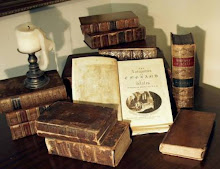
Over the weekend we packed it all in and took it all on the road. We did this for the first time in the dark and stormy
Chapter One Hundred Seven, but that turned out to be mostly a training run. With the promise of over 4,000 people, this would be the real thing.
This event was held in conjunction with the Morel Mushroom Hunting Festival headquartered at the Marshall-Putnam Fairgrounds. There were indoor and outdoor booths offering everything from hand lotion to decorative wood art, from art prints to kettle corn, from petting zoo animals to working blacksmiths. Oh, and lots of morel mushrooms as candles and shakers and walking sticks and ceramics and so on. The exhibition began Friday afternoon and ended Saturday afternoon.
There was lots of planning and preparation involved, as we conceived of a booth that looked more like a bookshop than a yard sale table with books on it. The appropriate shelving had to be freed from its current use at
Mad About Books International Headquarters, specifically the shelves in the back of the third last picture. That shelf was about twenty feet in length, and though we needed that much footage, it had to be broken down to transport. We supplemented with some nice simple knockdown units for the sides, and then added three half-shelves to form a small island in the center.
Next task was the selection and transportation of enough books to fill thirty-six feet of shelving. We took much of the same books that went to our first show, with a sample of most every other category in the store. To those were added numerous boxes of discount paperbacks. And away we go.

We arrived a little later than expected, due to some unforeseen challenges getting the shelves loaded for transportation. Once there, the unload and construction went smoothly. The vendor beside us did not seem too pleased to discover she would have a wall of shelves to the back of her booth, and would need to find another path behind her tables. But we were within our space, and we were not going to look like the other guys. Then the books needed to go back on the shelves. And try as one might to keep the same books together when boxing them up, one inevitably will be left with specific-sized spaces to fill, requiring books of that specific size which may not be in the same category of books already in the box. The result is when unpacking, books still have to be rearranged, and alphabetized, and so forth.
Because of our delayed start, the exhibition opened while we were still shelving books. Friday was an optional day, and designated set-up was any time during the afternoon or the next morning. However, people were already browsing Friday afternoon, and the sudden flurry of activity made finishing the shelving process a bit frustrating.
Now comes the part we have been waiting for--just relax and sell books. Many of the people were mushroom hunters who had arrived early, and had their campers parked on the fairgrounds, with nothing better to do in the small town of Henry, Illinois but to browse the exhibition tables. One of the first gentlemen to stop showed interest in a biography of John Wayne, and then wandered off to consult with someone else. By the time he had returned, only a few minutes later, someone else had bought the book. We had a few more sales and some interest in the store and some conversation with our neighbor vendors. Several commented they had never seen a setup quite like ours. Book sellers at other events were reported to put up one folding table and then take the lids off a bunch of boxes. Though we were inside a building, it was open, and the cool night breezes left us cold and unprepared. Though temperature tried to tempt us into departing early, two minutes before the lights went out for the evening we had our best two sales of the day.
The information we received had a specific timeline for Friday, but only a general schedule for Saturday. When we returned to the fairgrounds just before the start time of the event, the booths were already buzzing with activity. The mushroom hunters had begun arriving about an hour earlier, and so we had missed some traffic. But if we had been hunting for mushrooms that day, we would not have wanted to purchase a book and then carry it around with us (unless, perhaps, it was a guide to hunting mushrooms), so we hoped we hadn't missed any sales. Once the hunt kicked off, traffic died down until the exhibition shoppers began arriving as the morning progressed.
There had been a few people ask on Friday for certain books that we had left behind in the store, and so we brought those along Saturday. Most of those people came back, and some of the books were sold. One gentleman who had spent much of Friday evening browsing with us returned again for more. He had been one of the two best sales made Friday, and swore to limit himself this day to a single book. Immediately he took possession of said book, he spotted another of interest, and groaned loudly. He tried to figure a way out of purchasing the second book, assuming we would not be able to give change for a large denomination bill, but we assured him we could. The transaction was completed. He was done for the day, though promised he would be back for one more book if his wife would graciously allocate more funds to pay for his addiction. A few hours later the hunt was over, and many of the hunters returned with their spoils to shop, and business was mostly steady until the final two hours of the day.
Take down was smooth, though a slow process which in preparation we had spread over several days. We reloaded better than we had before. We turned around to have one last look, where the bustling market had once again become a wide open empty space. Our sales were good, much more than we would have done in the store on an average weekend. Once we considered our costs, though, profits were slim.

Books that sold the best this weekend were history, natural living, ships, some of the discount paperbacks, and, of course, mushrooms. Though our display seemed unusual, and truly stood out beside all the others at this event, our thoughts turn to an even more elaborate setup: an actual miniature book shop with window and door and roof to compliment the shelves. That, however, is an elaborate plan, and our present situation would call for a more stripped down process. To pursue this road to sales we would need some sort of folding shelves that are compact and easily moveable, yet sturdy enough for books. Even better would be cabinets or racks on wheels, so books could be placed on them and then simply rolled back and forth, eliminating the need to box and unbox all those books. Or maybe we should place them in a box and just open the box on the ground. We have much to consider before the next roadshow.