Showing posts with label books. Show all posts
Showing posts with label books. Show all posts
Saturday, March 12, 2011
Time Capsules
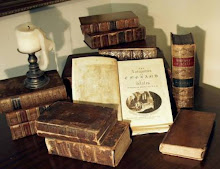
Books are time capsules. They store messages for a potentially endless period of time, and capture, like a photograph, the precise moment in time when they were created. And so, too, are they time machines. They wait upon the shelf for future generations to open them and receive the message. When they are opened, they transport the reader back to the time when they were created, as well as the time they depict.

Monday, October 5, 2009
The Good Book
The digital signal on the television froze just as our favorite team scored the winning points in the final seconds of the game. The browser suffered some unexpected failure and had to shut down. We found a radio station that plays all our favorite songs, but the transmission only reaches us on cloudless nights when we hold the tip of the antenna. Equipment needs to be repaired or replaced, or becomes so outdated as to be almost useless. We couldn't help but feel frustrated. Thankfully, comfort is near at hand.
A book is both the information on the printed pages, and the mechanism that delivers the information to us. Though printing was invented by the Sumerians, and the basic codex first appeared in the third century BCE, modern technology has not improved either form or function.
The information we receive in a book doesn't come with commercial interruptions or advertisements that pop up from the pages. We can easily navigate through the book using the table of contents or the index. Even without a pricey gadget, the information is available to us on demand, always appearing quicker than even the fastest download speeds. We can start or stop reading at any time, and page backward to reread or forward to skip ahead. We can even record our thoughts in the margins and highlight the critical parts. Best of all, these functions are right at our fingertips -- no remote necessary.
A book doesn't require any installation or set-up. There is no user's manual. Batteries, electricity, and gasoline are not needed; nor is an extended warranty to protect it against mechanical breakdown. Books are completely portable, without ever having connectivity issues or reception trouble. A bookworm might eat a tiny hole through some pages, but the book will never catch a virus that causes a loss of information or performance. And if a book does lose its cover, or if a few pages come lose, the information can still be accessed and used. A reader never need take a book back to the dealer for regular maintenance, or have a serviceman come to perform repairs.
More than just a container or infotainment, books have a pleasing aesthetic that just can't be found in a radio, television, or computer. Those things have their advantages, but none can touch the soul like a good book. What will we read tonight?
A book is both the information on the printed pages, and the mechanism that delivers the information to us. Though printing was invented by the Sumerians, and the basic codex first appeared in the third century BCE, modern technology has not improved either form or function.
The information we receive in a book doesn't come with commercial interruptions or advertisements that pop up from the pages. We can easily navigate through the book using the table of contents or the index. Even without a pricey gadget, the information is available to us on demand, always appearing quicker than even the fastest download speeds. We can start or stop reading at any time, and page backward to reread or forward to skip ahead. We can even record our thoughts in the margins and highlight the critical parts. Best of all, these functions are right at our fingertips -- no remote necessary.
A book doesn't require any installation or set-up. There is no user's manual. Batteries, electricity, and gasoline are not needed; nor is an extended warranty to protect it against mechanical breakdown. Books are completely portable, without ever having connectivity issues or reception trouble. A bookworm might eat a tiny hole through some pages, but the book will never catch a virus that causes a loss of information or performance. And if a book does lose its cover, or if a few pages come lose, the information can still be accessed and used. A reader never need take a book back to the dealer for regular maintenance, or have a serviceman come to perform repairs.
More than just a container or infotainment, books have a pleasing aesthetic that just can't be found in a radio, television, or computer. Those things have their advantages, but none can touch the soul like a good book. What will we read tonight?
Monday, May 14, 2007
Local Man in Despair Over Present State of Journalism
In "Why Don’t Journalists Get Religion? A Tenuous Bridge to Believers," Gal Beckerman writes
This afternoon, the local television news opened with a shooting, a fire, a car crash, a missing person, a trial concerning a recent homicide, and a trial concerning a murder over ten years old. None of it has any bearing on us.
What news did the travelers of medieval times bear? Probably such news was meant to convey information, expand knowledge and understanding of the world, and so covered political and economic issues, and inventions or other changes. Events like a gallop-by slaying, the burning of someone's hut, a nightsoil cart crash, a disappeared magician, and a witch-trial, meant to captivate, titilate, and entertain an audience, probably fell to the troubadour to relate. Though they might have been true, they were correctly presented as stories. So the tease on television today goes, "These and other stories coming up at ten." Such is the state of modern local news, feeding us stories.
A regular feature of this news is the bad thing that someone did because they read it in a book, or saw it in a movie. The news is usually purported to be the uproar after, when angry book-hating parents demand that Setting Free the Bears be banned before another child decides to let all the animals out of the zoo; or Interview With a Vampire be removed from the shelves because it has glamorized the sucking of blood and the sleeping in coffins, and there is an epidemic of troubled Goth teens. The blame on books is nothing new, though, as even in the 1830s a defendant claimed he never would have comitted murder if he had not read about the crime in William Harrison Ainsworth's novel Jack Sheppard. Surely this can't be the only news there ever is? Why don't we ever hear about someone inspired by a book to do something good?
The Bible is said to contain the Good News. Though one can easily argue the cons of religious tomes such as the Bible or the Koran, these books have certainly inspired millions of people to be good and do good, especially in charity. How many people have been charmed by Walden into becoming a naturalist? How many people would ever fall in love if they had not read of it in books? How different would the American Revolution have progressed if the colonials had not been inspired by the writing of Thomas Paine? Not everyone wants to rule the universe; some, if not more, want to save it.
Though The Onion is meant as parody, often they feature wonderful stories about simple good things, like "Local Homemaker Fights To Overcome Rubbermaid™ Addiction." Isn't this something we all must face at some time in our life? What has happened that the presentation of some good act or useful information is found merely humorous?
Novelist Gena Showalter encourages her readers to share their news. Never is it my husband left me, or my son failed his algebra test, or my boyfriend just ran over my cat.
Local news could stand being turned on its head. Fill up the first ten minutes or so with those feel-good stories that are usually relegated to the end, and save the murder story for the closing seconds (if the weatherbabe doesn't go long).
The Great Space Coaster had a character that was a talking gnu. Gary Gnu hosted a segment that was called The No Gnews Is Good Gnews Show. We think Gary had the right idea.
“Religious issues, issues of faith, issues of moral choice, those burdens and struggles that all human beings undergo — those issues deeply interest me,” {New York Times reporter Chris] Hedges says. “Death, birth, love, alienation, sin. This is the real news of people’s lives.”Later in the same essay, Steve Waldman, co-founder of Beliefnet, says, “In the life of an individual, the big news event is not who came in second in the Iowa caucus. It’s the death of their parents, the birth of their child.”
Yet those are the stories we almost never see.
This afternoon, the local television news opened with a shooting, a fire, a car crash, a missing person, a trial concerning a recent homicide, and a trial concerning a murder over ten years old. None of it has any bearing on us.
What news did the travelers of medieval times bear? Probably such news was meant to convey information, expand knowledge and understanding of the world, and so covered political and economic issues, and inventions or other changes. Events like a gallop-by slaying, the burning of someone's hut, a nightsoil cart crash, a disappeared magician, and a witch-trial, meant to captivate, titilate, and entertain an audience, probably fell to the troubadour to relate. Though they might have been true, they were correctly presented as stories. So the tease on television today goes, "These and other stories coming up at ten." Such is the state of modern local news, feeding us stories.
A regular feature of this news is the bad thing that someone did because they read it in a book, or saw it in a movie. The news is usually purported to be the uproar after, when angry book-hating parents demand that Setting Free the Bears be banned before another child decides to let all the animals out of the zoo; or Interview With a Vampire be removed from the shelves because it has glamorized the sucking of blood and the sleeping in coffins, and there is an epidemic of troubled Goth teens. The blame on books is nothing new, though, as even in the 1830s a defendant claimed he never would have comitted murder if he had not read about the crime in William Harrison Ainsworth's novel Jack Sheppard. Surely this can't be the only news there ever is? Why don't we ever hear about someone inspired by a book to do something good?
The Bible is said to contain the Good News. Though one can easily argue the cons of religious tomes such as the Bible or the Koran, these books have certainly inspired millions of people to be good and do good, especially in charity. How many people have been charmed by Walden into becoming a naturalist? How many people would ever fall in love if they had not read of it in books? How different would the American Revolution have progressed if the colonials had not been inspired by the writing of Thomas Paine? Not everyone wants to rule the universe; some, if not more, want to save it.
Though The Onion is meant as parody, often they feature wonderful stories about simple good things, like "Local Homemaker Fights To Overcome Rubbermaid™ Addiction." Isn't this something we all must face at some time in our life? What has happened that the presentation of some good act or useful information is found merely humorous?
Novelist Gena Showalter encourages her readers to share their news. Never is it my husband left me, or my son failed his algebra test, or my boyfriend just ran over my cat.
Local news could stand being turned on its head. Fill up the first ten minutes or so with those feel-good stories that are usually relegated to the end, and save the murder story for the closing seconds (if the weatherbabe doesn't go long).
The Great Space Coaster had a character that was a talking gnu. Gary Gnu hosted a segment that was called The No Gnews Is Good Gnews Show. We think Gary had the right idea.
Thursday, March 8, 2007
Sticky Situations
Why do publishers and retailers find it necessary to place stickers on every book? Stickers that say this book won the Most Unknown Award, or was autographed by the fact-checker, or is marked 30% off the original outrageous price, or is part of the general stock in an independent-crushing Big Box store. Sometimes there will be a sticker with a scannable bar code placed over the scannable bar code printed on the book. Move further down the retail chain and books can be found with price stickers from ticketing hand guns slapped all over, sometimes on the flyleaf as well as the cover, just in case some bored housewife tries to switch tickets. Of course, librarians with unlimited budgets have all kinds of stickers to apply to the inside and outside of every item in their collection. They also must have stock in 3M, because they like to use an abundance of tape as well, to make sure a curious ten-year-old doesn't take the dust jacket off The Borrowers and put it over Lady Chatterly's Lover, because children don't need to learn about sexual relations, they need to learn how to deal with those tiny people that live in their walls and steal their homework. When colleges buy back your $90 hardly used textbook for $5, and then offer it to a new crop of poor students the next semester for $45, they like to apply to the spine a pesky little sticker that identifies the volume as used. We might even go so far as to question Aunt Henna's need to apply her flowery feline bookplates to every volume that passes through her hands on the chance that all those Victoria Holts and Phyllis Whitneys associated with her might have a premium value for collectors. Or Uncle Randle's joy in licking and sticking his address plate on the flyleaf of all his books, so if one ever wanders away and doesn't have cab fare home, some good Samaritan can just drop it in any mail box and it will be delivered back to its worried owner.
Do you get the feeling we don't like things stuck on books?
Cliff Janeway, John Dunning's Bookman, tells us what is commonly known as lighter fluid works great at removing stickiness, dries fast, and leaves no residue or stain. He also warns that it can be soaked through the skin into the bloodstream, so if you have clogged arteries, it will slick those cells right up and get everything flowing freely again. We have a gum eraser, which works well on some types of paper, and not so well on others. Fingernails can be employed, though they can leave incriminating indentations or scuffs. The sticker disease is so widespread and debilitating that we know people who specialise in their removal, and will do that work for others at quite special prices.
The stickers printed with the book information and a scannable bar code usually cooperate when it comes time for removal. Others cling to the book like snot on a sleeve; one needs a sand blaster to get them off. Still others refuse to go without taking part of the dust jacket or leaf with them. In such a case, what is one to do, leave the offensive leech attached, or forcibly remove it and endure the stigma of a permanent scar? When one is peeling back a certain sticker slowly but surely, hope of success mounting with each second, and then suddenly the dust jacket tears: that is sticker shock.
Today we call for an end to all stickers on books, which are nothing more than the literary equivalent to grafitti. Stop the madness. Do it for the children. Peel off those stickers and send them back to the publisher or retailer: tell them to stick it. Or get your Congressman involved, asking him to do something about this terrible crime against readers. And why not demand reparations as well? A class-action lawsuit might not be out of order. Failing all that, do unto others as they have done unto you: start putting Dr. Suess "I Love Reading!" stickers on all forms of payment when purchasing any book.
Do you get the feeling we don't like things stuck on books?
Cliff Janeway, John Dunning's Bookman, tells us what is commonly known as lighter fluid works great at removing stickiness, dries fast, and leaves no residue or stain. He also warns that it can be soaked through the skin into the bloodstream, so if you have clogged arteries, it will slick those cells right up and get everything flowing freely again. We have a gum eraser, which works well on some types of paper, and not so well on others. Fingernails can be employed, though they can leave incriminating indentations or scuffs. The sticker disease is so widespread and debilitating that we know people who specialise in their removal, and will do that work for others at quite special prices.
The stickers printed with the book information and a scannable bar code usually cooperate when it comes time for removal. Others cling to the book like snot on a sleeve; one needs a sand blaster to get them off. Still others refuse to go without taking part of the dust jacket or leaf with them. In such a case, what is one to do, leave the offensive leech attached, or forcibly remove it and endure the stigma of a permanent scar? When one is peeling back a certain sticker slowly but surely, hope of success mounting with each second, and then suddenly the dust jacket tears: that is sticker shock.
Today we call for an end to all stickers on books, which are nothing more than the literary equivalent to grafitti. Stop the madness. Do it for the children. Peel off those stickers and send them back to the publisher or retailer: tell them to stick it. Or get your Congressman involved, asking him to do something about this terrible crime against readers. And why not demand reparations as well? A class-action lawsuit might not be out of order. Failing all that, do unto others as they have done unto you: start putting Dr. Suess "I Love Reading!" stickers on all forms of payment when purchasing any book.
Subscribe to:
Posts (Atom)